
The morning of the 27th of April was to be our first day of the heritage tour that would take us all over the province of Iloilo. The entire party was up early and by seven in the morning, people were arriving at the appointed rendezvous to kick off the tour. We started milling around in the plaza of the San Jose de Placer Church in Iloilo City for a while as there was a Mass being held and it was improper to just barge in and take the obligatory photo documentation of this lovely church. Following the Spanish lay-out of the town the church is bounded by the Plaza Libertad and the municipal building. Across it would be the Freemason headquarters and the former Iloilo hotel with its graceful portico. Road improvement projects at the front of the church mar the view as there were heavy machinery parked in front of the Spanish style convento situated at the left of the church.

Started in 1873 by Fr. Mauricio Blanco, O.S.A., who also started the two rectangular belfries flanking the church in 1893. The church was repaired by Fr. Manuel Diez in 1902. It was spared from destruction in WWII and was restored by Engineer Mariano Cacho of the Panay Electric Company. The church was again renovated in 1980-'82 by Agustinian priest Fr. Andres de Centina using Romblon marble on its transept, presbytery, main and side altar walls, and floors. A main feature is its altar gilded with 17,000 gold panels undertaken by Fr. Jesus Fernandez. It has three knaves and a transept marked with fluted columns in Corinthian style. The Byzantine church has a semicircular arched main entrance with minor entrances on each side. Six Ionic columns support the twin belfries and a pediment with a statued niche on the tympanum. It also has semicircular arched windows and rose windows on its facade.
They also house the image of the Nstra. Sra. del Rosario, an image found on the 29th of September, 1614 during the defense of Iloilo by Corporal Diego de Quinones against the invading Dutch fleet headed by Admiral Georges Spillberg It was taken in a solemn procession to the church by Fathers Geronimo Alvarado and Juan de Morales.The Statue was damaged in 1850 church fire and restored in Manila in 1873 and restored again in 1907 by Sra. Dna. Candelaria Soriano vda. de Cacho* ( A Tourist Guide to Notable Philippine Churches, Benjamin Locsin Layug, New Day Publishers, 2007)

We met our Iloilo guide as we were leaving the church and boarded the bus for our next destination. As it turns out, Roy Gatpatan is the cousin of my next door neighbor here in Manila. I've been making friends with close Manila connections, how cool is that? Roy Gatpatan was most entertaining with commentaries injected with humurous anecdotes and stories eliciting hearty laughter from us.

We first did a city tour going through Calle Real where heritage buildings stand side by side and still intact and in use. Graceful architecture still abounds in Iloilo City with the buildings' dates proudly displayed on their unique facade. Deep inside I'm thinking, had Escolta not been bombed in WWII, it would have looked like Calle Real. We also went around the university belt of Iloilo where learning institutions have proudly produced technocrats, political figures, health workers and seafarers. This prompted our guide to quip that "awareness of heritage has something to do with the literacy rate of a city." Once again, the laughter...

A lot of us missed breakfast for fear of missing the early call time, so it was a treat stopping by the Camina Balay nga Bato at a small sleepy district called Villa de Arrevalo. Originally known as La Villa Rica de Arrevalo the adjective has been dropped over the centuries. It is said that when the Queen Isabel II was deposed because of the Salic Law, the Vireinato (viceroyalty) was transferred to this location thus earning the title rich village. An obelisk at the plaza with a crown on its apex symbolizes the patronage from the queen.

We were met at the ground level by the current owner and resident of the heritage house, Luth Camina Avancena welcomed us and spoke of the house history. She is the 4th generation occupant of the home built on the support of 24 hardwood posts covering the entire floor area of the home. Built in 1865, the home is an elegant throw back of generations of family members that have introduced little changes over the years. Their main draw is an experience of sipping piping hot, thick chocolate from a baterol. The chocolate comes with crispy crackers or rosquillos for dipping into the thick coco. To get a refill, one merely rings a small bell and the server comes to you with pewter pitcher of hot chocolate brew in hand. It harks back to the time when the dons and donas need not raise their voice to call house help. At the mere tinkling of a bell, they come running to fulfill your every whim.

We then proceeded to the San Joaquin Church, in San Joaquin where we were met by the officer in charge for tourism Ms Erlyn Alunan. The church of San Joaquin is a success story of restoration. Located 53.5 km west of Iloilo City, it sits on a plain overlooking the sea. The church is a declared National Treasure. It is constructed of gleaming white coral rock quarried from the shores of Punta Maligting, Bgy. Igcadlum, Igbaras. Fr. Thomas Santaren, O.S.A. headed the construction of the church in 1869. The simple facade has three sections. The ground level has an arched main doorway with coupled pilasters dividing it in three sections. On each side of the entry way are statued niches. The choir loft level has two niches as well and a statued niche at the center. The triangular pediment has two sets of finials on the top. The unique feature of the church is its high bas relief of the Rendicion de Tetuan depicting the victory of the Spanish forces under Spanish General Leopoldo O'Donnell over the Moorish forces under Moorish Crown Prince Muley Abbas. The relief was done in red, blue and yellow mosaic carved in stone blocks and mounted on the pediment.which was added halfway through the construction of the church by Fr. Santaren, Spanish Engineer Felipe Diaz and a Filipino (some say Chinese) carver.


Started in 1873 by Fr. Mauricio Blanco, O.S.A., who also started the two rectangular belfries flanking the church in 1893. The church was repaired by Fr. Manuel Diez in 1902. It was spared from destruction in WWII and was restored by Engineer Mariano Cacho of the Panay Electric Company. The church was again renovated in 1980-'82 by Agustinian priest Fr. Andres de Centina using Romblon marble on its transept, presbytery, main and side altar walls, and floors. A main feature is its altar gilded with 17,000 gold panels undertaken by Fr. Jesus Fernandez. It has three knaves and a transept marked with fluted columns in Corinthian style. The Byzantine church has a semicircular arched main entrance with minor entrances on each side. Six Ionic columns support the twin belfries and a pediment with a statued niche on the tympanum. It also has semicircular arched windows and rose windows on its facade.
 |
| St. Joseph convento |

We met our Iloilo guide as we were leaving the church and boarded the bus for our next destination. As it turns out, Roy Gatpatan is the cousin of my next door neighbor here in Manila. I've been making friends with close Manila connections, how cool is that? Roy Gatpatan was most entertaining with commentaries injected with humurous anecdotes and stories eliciting hearty laughter from us.

We first did a city tour going through Calle Real where heritage buildings stand side by side and still intact and in use. Graceful architecture still abounds in Iloilo City with the buildings' dates proudly displayed on their unique facade. Deep inside I'm thinking, had Escolta not been bombed in WWII, it would have looked like Calle Real. We also went around the university belt of Iloilo where learning institutions have proudly produced technocrats, political figures, health workers and seafarers. This prompted our guide to quip that "awareness of heritage has something to do with the literacy rate of a city." Once again, the laughter...

A lot of us missed breakfast for fear of missing the early call time, so it was a treat stopping by the Camina Balay nga Bato at a small sleepy district called Villa de Arrevalo. Originally known as La Villa Rica de Arrevalo the adjective has been dropped over the centuries. It is said that when the Queen Isabel II was deposed because of the Salic Law, the Vireinato (viceroyalty) was transferred to this location thus earning the title rich village. An obelisk at the plaza with a crown on its apex symbolizes the patronage from the queen.

We were met at the ground level by the current owner and resident of the heritage house, Luth Camina Avancena welcomed us and spoke of the house history. She is the 4th generation occupant of the home built on the support of 24 hardwood posts covering the entire floor area of the home. Built in 1865, the home is an elegant throw back of generations of family members that have introduced little changes over the years. Their main draw is an experience of sipping piping hot, thick chocolate from a baterol. The chocolate comes with crispy crackers or rosquillos for dipping into the thick coco. To get a refill, one merely rings a small bell and the server comes to you with pewter pitcher of hot chocolate brew in hand. It harks back to the time when the dons and donas need not raise their voice to call house help. At the mere tinkling of a bell, they come running to fulfill your every whim.

We then proceeded to the San Joaquin Church, in San Joaquin where we were met by the officer in charge for tourism Ms Erlyn Alunan. The church of San Joaquin is a success story of restoration. Located 53.5 km west of Iloilo City, it sits on a plain overlooking the sea. The church is a declared National Treasure. It is constructed of gleaming white coral rock quarried from the shores of Punta Maligting, Bgy. Igcadlum, Igbaras. Fr. Thomas Santaren, O.S.A. headed the construction of the church in 1869. The simple facade has three sections. The ground level has an arched main doorway with coupled pilasters dividing it in three sections. On each side of the entry way are statued niches. The choir loft level has two niches as well and a statued niche at the center. The triangular pediment has two sets of finials on the top. The unique feature of the church is its high bas relief of the Rendicion de Tetuan depicting the victory of the Spanish forces under Spanish General Leopoldo O'Donnell over the Moorish forces under Moorish Crown Prince Muley Abbas. The relief was done in red, blue and yellow mosaic carved in stone blocks and mounted on the pediment.which was added halfway through the construction of the church by Fr. Santaren, Spanish Engineer Felipe Diaz and a Filipino (some say Chinese) carver.

We made a short stop to sample some of San Joaquin's delicacies at Do Doy's (AHP San Joaquin) residence and to admire his collection of old photos, shards of hand painted Florentine tiles, artwork of old churches. Then we proceeded to the Campo Santo of San Joaquin. Ms Erlyn regaled us with a history of the town's noble past. Some of the locals, Ms Erlyn included, trace their ancestry back to the ten Bornean Datus who fled Sultan Makatunaw's cruel reign during the Sri-Vijaya empire c. 1250 A.D. These ten Datus were:1. Datu Puti (the leader), 2. Datu Balensusa, 3.Datu Bangkaya, 4. Datu Dumalugdog, 5. Datu Dumangsil, 6. Datu Dumangsol, 7. Datu Lubay, 8. Datu Panduhinog, 9. Datu Paliburong, 10. Datu Sumakwel. Ms Erlyn is a direct descendant of Datu Paliburong.

The Campo Santo of San Joaquin is built on a hillside with an imposing chapel right smack ini the center of the public cemetery. Located on the outskirts of the town, it was supposedly intended for the final resting place of victims of a cholera outbreak. Unfortunately, the cemetery has come under controversy quite recently. The pride of San Joaquin residents and also a National Treasure became the site of a treasure hunting spree that was spearheaded by the parish priest Nelson Silvella. Treasure hunters were caught red-handed while digging 60 feet under the mortuary chapel seeking gold in the dead of night. Witnesses and the caretaker (bribed by the priest) filed a complaint to the police who apprehended ten men involved in the crime. The priest has been relieved and is currently in hiding. Ms Erlyn made her leave from there and we back tracked towards Miagao for our lunch and to experience a World-Heritage site.
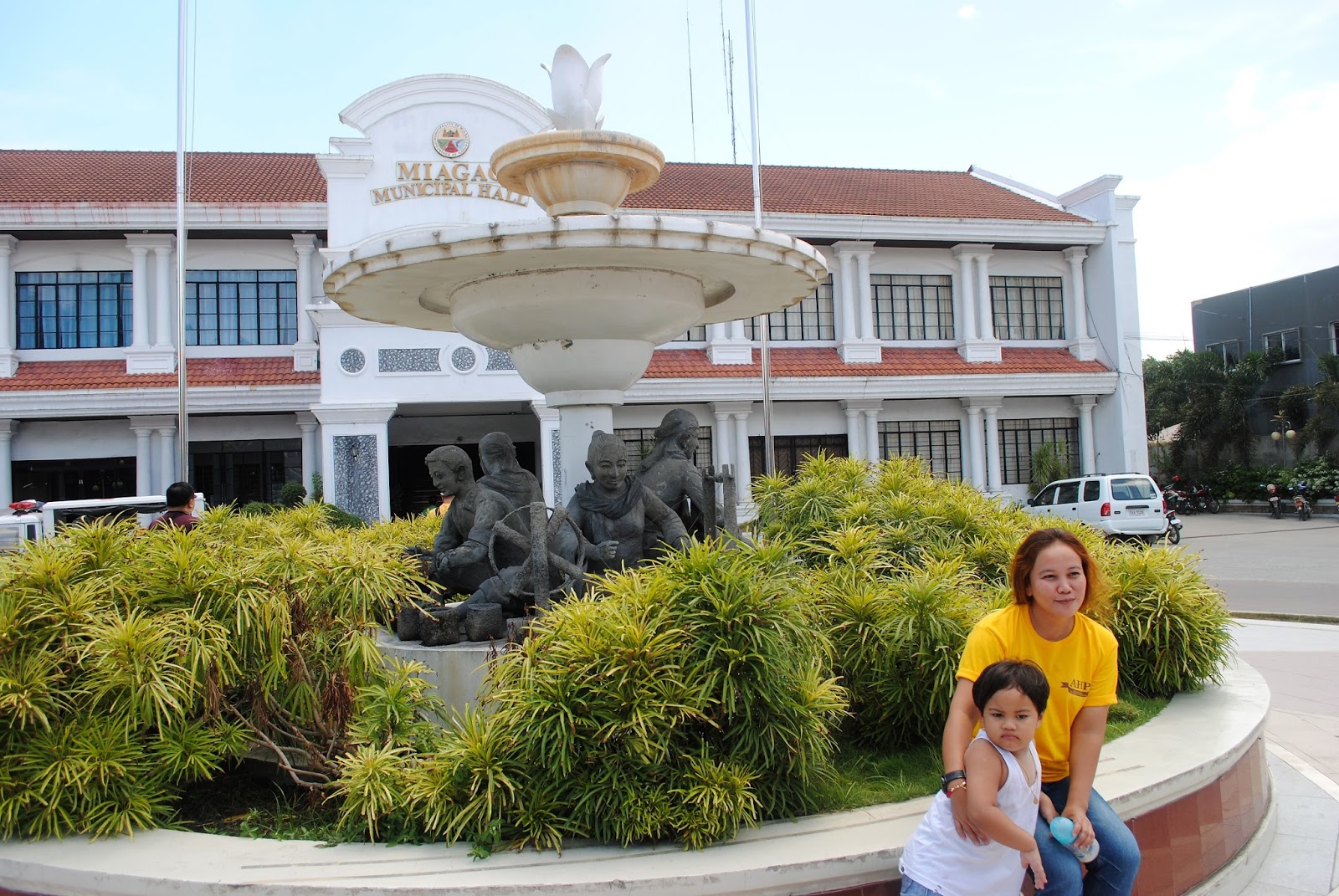
Lunch at Miagao Municipal Hall was sponsored by the local government. We were warmly welcomed at the town Hall and they were only too happy to have an AVP of the town's history and it's national treasure. at the lobby were samples of the local weave called Hablon. The town takes it name from the Miagus plant that grows abundant in the area. But more than a heavy lunch, I had a drink of water at a 7-11 building that blocks the view of the church from the road. Another photo bomber of a national treasure!

Maigao Church is an imposing building built like a fortress. There's good reason for this. The town, along with San Joaquin and Guimbal lie near the ocean. It was a favorite haunt of slave traders who would raid the town to capture locals and sell them off as slaves. Miagao in the third church built in the area on top of a hill called Tacas (escape). The first church was built in 1734 and burned to the ground by Moro raiders in 1741. The second one built by Fr. Fernando Camporredondo from 1744 to 1750 was also burned and looted by pirates in 1754. The existing one was built by Fr. Francisco Maximo Gonzalez in 1786 of huge stones quarried from Sitio Tubo (San Joaquin) and completed by maestro de obras from Igbaras in 1797.

The elements have not been kind to Miagao Church but its construction has mostly weathered natural disasters and wars. In 1864, Agustinian priest, Fr. Agustin Escudero undertook restoration of the church, and in 1880 interiors were done by Fr. Jose Sacristan. In 1898 the church succumbed to fires and American War 1910. Damaged by an earthquake in 5 Jan 1948. Restored by Archbsp. Wenceslao Enojo in 1959. In 1962 Msgr. Leonardo Javillo and NHI chairman Esteban Ocampo did restoration as well. A marker was installed by National Historical Institute under Director Luis Montilla on 16 February 1963. 1 August 1973, Maigao was a declared land mark, and in 1994 it was declared a UNESCO World Heritage Site.

Miagao is certainly the most beautiful of the World Heritage Churches in the country. It has four meter thick walls of sand stone. The facade has Filipino motif in high relief depicting the giant image of St. Christopher carrying the child Jesus on his shoulder. Philippine flora dominates the motif. A coconut tree serves as the support for St. Christopher flanked by fruit laden Guava and Papaya trees representing fertility. The lower portion has a semicircular arched entry framed by two pillars. On each side of the entrance are statued niches. Sto. Tomas de Villanueva, the patron saint is in the central niche of the choir loft section with a heavily decorated frieze and the pediment has the high bas relief of of the Filipinized artwork reminiscent of the Aztec style design. Acanthus leaves are included in the decorative patterns of the design. The bell towers are asymmetrical with half circular buttresses. The left has four stories while the right has three. These were later additions during construction in 1839 by Father Francisco Perez. The pealing of the bells warned of invasion and pirate raids and the lower tower allowed for sound to travel farther inland as a warning to locals.

We sort of back-tracked our way from San Joaquin to Miagao and passed through Taytay Boni which is one of the last remaining Spanish bridges in the country. The bridge is remarkably well-preserved and kept from vandalism with a wrought iron fence around it. Built in 1854, the bridge stands as a testament to Spanish engineering. Bonifacio Neular is credited for designing the bridge which allows the overflow of water from the mountains to drain out to the ocean. The bridge is 35 meters long, 6.7 meters wide with 1 meter walls. Yellow sandstone called tablea is the main composite of the bridge which was de-commissioned in the 1960's when the new highway was built. The bridge lies on the outskirts between Miagao and Guimbal. Speaking of Guimbal, the town is known for its vanishing mansion. The story goes that on certain evenings a beautiful lady will hail a cab and direct the driver towards Guimbal. Once the mansion is in sight, the lady will disembark from the cab with directions for the driver to pass another route. When the driver turns around, the mansion is nowhere in sight. A marker with an effigy of a white lady and the tree where the mansion is supposed to be located marks the mystical spot.

Lazaro Ancestral House in Iloilo City was our next stop. Another Bahay na Bato, the house is notable as it was visited by no other than national hero Jose Rizal on his way from Dapitan to Manila. Apparently, the patriarch Don Raymundo Melliza was a classmate and close friend of Jose Rizal who served as a chief magistrate in Cuba and advised him about the Cuban settlement which Rizal wanted to move to in lieu of his imprisonment and eventual execution. The request he made was denied by the Spanish authorities and Rizal ended up walking to his execution. The house is now occupied and is our venue for merienda of a Pancit Molo and empanada. The house is expansive and has a big blow up of Jose Rizal in the caida. Unfortunately, i took much of my time taking stock of the photographs I had for the day and they ran out before I could experience it.
 |
| Relic of St. Anne |
It was a short drive to Molo Church and the sun was beginning to set so I immediately made my way to the church dedicated to St. Anne. While taking photos, I saw Mike Asinas who tagged me along to the old convento to take photos of their collection of antiques and to see the relic of St. Anne. Nothing beats the luster of old wood and I admired the items on display at the convento of Molo Cathedral. They have the ecclesiastical chair which Pope Paul IV used on his visit to this church. Incidentally, the second Filipino saint, San Pedro Calungsod, served in the church in his prime before he was martyred while evangelizing the local Chamorro indigenous people in Guam along with Jesuit saint Diego Luis de San Vitores.

Made of coral stone in 1831 under the supervision of Don Jose Manuel Locsin. The church withstood the bombing of WWII but the belfries were destroyed. It was restored after the war. It has five retablos and stained glass windows on its walls. The church is known for the images of 16 female saints that line the knave. The main facade is divided into three sections and arched main doorway flanked by coupled pillars. the upper segment has an arched stained glass window in the center and the windows on the belfry are arched as well. Rose windows are placed on top of the windows while a bas relief of Jesus is placed on top of the stained glass. The pediment has a niche with the statue of St. Anne. The third level of the belfries have finials and topped with turrets.


Across the plaza is the Yusay Mansion. Now, I personally left out the Consing name in deference to the wishes of a dear dear friend and mother figure who shall be left un-named. The Yusay mansion apparently was never owned by the Consing family. According to her, one of the Yusay daughters married into the Consing family and that he eventually became mayor of the town. They did live in the mansion during his term. As part of his duties, the mayor would allow audience to his constituents who needed assistance in a myriad number of things. Not that he wasn't any good as a public official. From what I hear, he was indeed, an efficient mayor of Molo. But the name stuck. When they sold the mansion to SM Kultura, there was included a clause which prevents the mansion from being torn down. So the mansion was restored to its former glory. The second level was supposed to become a mini museum on the history of the property. That is yet to materialize.
 |
| Yusay Mansion |
So after a long day spent practically jumping in and out of the bus, we were dropped off at the hotel to have our dinner anywhere we wanted. Our hotel was next door to its mall. We had dinner at a small restaurant called Chika-an where we sampled their version of tuna sisig, chicken inasal and a veggie dish which i can no longer recall. The dinner was alright... but the conversation and the laughter was simply superb!!!


