Pages - Menu

Monday, June 30, 2014

NATIONAL ARTIST!

Even if I dream of becoming hailed as a National Artist, I doubt that anyone would ever nominate me. I do, however, gloat in the fact that two of my mentors have been given the recognition... and the distinction of being proclaimed as such. 

*image from photobucket

Alice Reyes is credited for establishing Ballet Philippines. She is a tour de force on her own. Currently Artistic Director Emeritus, she has almost single handedly steered the course of Ballet Philippines from its inception up to the present... the only ballet company in the country that has survived for 45 years. And that, my dear readers, is a remarkable feat! Hailed for its dancers' innate musicality, astounding classical and contemporary techinque and ground-breaking choreographic pieces; this company has and continues to reap rave reviews here and abroad. 

*image from photobucket

Alice Reyes was Artistic Director for 20 years, exposing the dancers to rigid training and exposure abroad as well as inviting foreign choreographers, dance educators and prima ballerinas and premiere danseurs to inspire the younger set to pursue higher goals. She continues to check up on the company's progress when she's not busy tending to her own business empire.

*image from Inquirer.net
                                           
When Senator BongBong Marcos proposed  that Ballet Philippines be declared a national dance company, the proposal fell flat perhaps because a lot of our so-called "nationalists" thought the company was founded by the Marcoses. That is soooo not true! Although the company is one of the resident companies of the CCP, its dancers and staff were some of the staunchest supporters of Mrs. Aquino during the EDSA revolution even daringly donning yellow shirts when tapped for KBL rallies as a sign of defiance. Then when Mrs. Aquino ascended the presidency, she showed her gratitude by allowing Kris Aquino to participate in the Rigodon de Honor sequence of the Filipinized version of the Nutcrakcer.  But I digress...
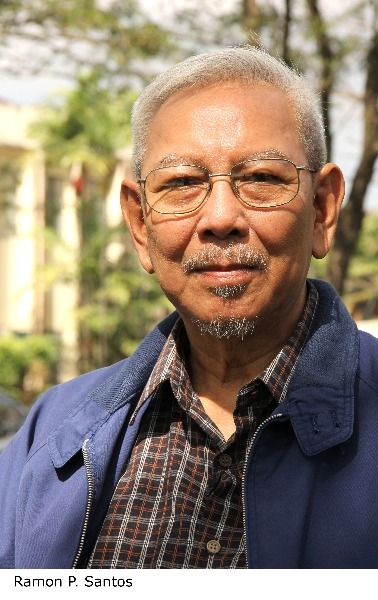
*image from photobucket

The other National Artist I wish to acknowledge is Ramon Santos. He has been teaching music at the UP Conservatory for years and his works have been acclaimed as worthy for dance choreographies. It was a great surprise to me that dear friend and former Ballet Philippines soloist Hazel Sabas Gower used his music for her choreographic work Daragang Magayon. In his lectures during my training for the Mabuhay Guides, he brings up this fact (with slides and video to boot). That was extremely satisfying for me... I didn't even know it was his music. I had done the costume designs for Hazel's work without knowing it was Ramon Santos' who did the score. After being dropped from the roster by Mrs. Arroyo last time, due credit comes his way. Finally, he can be counted as an inspiration for those who have unwittingly listened, choreographed or danced to his music along with the other Philippine greats.

*image from Tumblr.com

This year's crop of National Artists are beyond question (think Carlo Caparas and Cecile Guidote brouhaha a few years back!). Francisco Coching ( for Visual Arts), Cirilo Bautista (for Literature), Francisco Feliciano (for Music), Jose Ma. Zaragoza (for Architecture, Design and Allied Arts) are the other awardees. The only question left, I guess, is when will Nora Aunor get the esteemed title? Deserving as she is, Ms Aunor has been dropped from the roster (much to the chagrin of Noranians everywhere.) Nonetheless, the controversy is still a hot issue with fans and cineastes rooting for her to be proclaimed a national artist as well... If she isn't given the title now... she can get nominated again. Maybe after 2016?

Sunday, June 15, 2014

Olympics Of Dance

Jemima and Victor in Black Swan pas de deux

Dancers in the Philippines are unsung heroes. I should know... been there, done that!

Victor Maguad as Sigfried
Lately, though, some of them are getting media attention: 1) because they have literally worked their way into our national consciousness, 2) they arre really good at what they do, 3) cyberspace just has a way of finding those little "unknowns" who eventually leave a mark on this planet because they have made their passion thei life's work.

Victor  Maguad and Jemima Reyes

Three of these dancers from Ballet Philippines will be showing their mettle in Jackson, Mississippi when they compete in the Olympics of Dance and at Varna, Bulgaria. Actually, four dancers if you count Jayson Pascasio who happens to be now based in the US but has his roots reaching far back to Ballet Philippines as a soloist.

Jemima as Odile
Jemima Reyes, Victor Maguad and Monica Gana will be making the Philippines proud when they represent the country this year in the world's most prestigious dance competitions. As of this writing, Jemima and Victor are already in Jackson where they are in the thick of preparations for their choreographies. The duo will be performing the Black Swan pas de deux, Diana and Acteon and Alden Lugnasin's contemporary piece Aku, along with some required choreographies. Jayson, to their surprise, is also a competitor.

Monica Gana as Esmeralda
Monica Gana, on the other hand, will be awaiting her turn when she goes to Varna, Bulgaria to do her best and show the stuff she's made of. Her repertoire includes solo variations from La Bayadere ( Gamzatti), Esmeralda, Don Quixote (Kitri), Flames of Paris and Giselle. 

Monica Gana as Kitri
All of these dancers are extremely young and at the top of their game. The last time we bagged a trophy was when JM Cordero and Candice Adea competed. They won the silver medal in Jackson and Gold in Helsinki, Finland. That was four years ago. And YES, preparations to compete can sometimes take that long to pursue. I'm praying this year's crop reaps all the awards they deserve! 

Tuesday, May 27, 2014

The "Pen" Promotes the Philippines


On a recent assignment, I was tasked to show guests of the Manila Peninsula Hotel around Intramuros. Part of the itinerary was sent to me via text message and I was mildly surprised that some of the stops to be made were not the usual tourist routes. It seemed odd that the other sites to be visited were more artisanal than the usual tourist souvenir shops.

Aussie journalists viewing  Eugene  Jarque's artwork
It was odd but those were the orders so I decided to dutifully stick to the itinerary. Then when I, on board the Jeepney Tours vehicle stopped at the Manila Pen, I realized this was no ordinary tour. It was part of the Manila Peninsula's corporate responsibility program which invites journalists from different countries to visit the Philippines and promote the country by showcasing the best of what we have to offer.
Lilliana Manahan's installation

On this tour, I was introduced to four Australian journalists and Peninsula Sydney's PR Director Sue as well as Peninsula Manila's PR Director, Maning Garchitorena. While waiting for the other members of the touring party, I had to adjust pretty quickly as everyone was pretty witty... punchlines were thrown at me from left, right and center. You'd have to be ready with funny repartee to catch up.

Manila Pen's table setting 
The stops after lunch were inspiring, to say the least. We went to the La Fuerza Compound in Pasong Tamo Extension. What was formerly a distillery has been re-purposed into different atteliers. The first stop was at Gallery where three young visual artists whose works we viewed. Lilliana Manahan had an installation of seventeen layers of drapes that were handpainted aside from smaller frames. Eugene Jarque who featured his frames of wooden collages and Mac Valdezco had her sculptural pieces in plaster and rope. Her pieces seemed like they came from archeological digs and looked very organic.

Mac Valdezco's sculpture
Manila Pen had an elaborate set-up for lunch that served updated versions of adobo, lumpia, and caldereta. I had all been so good that while the conversation kept flowing so did the food and the wine. But since I was on assignment, i begged off on the bubbly and stuck to the cucumber and sprite drink that was so refreshing on a hot summer day.

Manila Pen's menu card and cucumber sprite coolie
Ms Kaye Tinga (wife of former Pateros Mayor) and Andy Vasquez Prada of  W17 joined us for lunch after which we proceeded to their store within the compound. All the items in their store are unique finds albeit pricey. You get what you pay for, of course, but their items can hold your attention for hours. I fell in love with a dining table made of one humongous plank of acacia tree. It could've probably seated 20-25 people comfortably. I didn't dare to ask the price... If have to ask... you can't afford it.
W17 facade
Then we headed off to Dasmarinas Village for a private fashion show of Len Cabili's clothes and Natasha's jewelry. This tandem come from two distinct regional backgrounds. Len hails from the south and so early on she was interested in local weaves while Natasha comes from mixed  Ifugao/Australian parentage. It was so awe-inspiring that Michael McHugh of Mindfood Australia decided to feature both of the designers exclusively in his glossy mag.


The entire day was a lot of fun and an eye opener for the guests courtesy of one of the better hotels in Manila. The following day, the guests were whisked off to Amanpulo in Palawan for the weekend.  I'm so hoping they invite me again the next time around.

Andy Vasquez Prada and Mrs Kaye Tinga in thier store W17


Wednesday, May 7, 2014

Treats from La Cocina de Tita Moning

Two days prior to President Obama's historic visit to Manila, I was tasked by the Tourism Board of the Philippines through Jeepney tours to guide for a motley group of Australians who are in the business of promoting the Philippines as a tourist destination.

Legarda Mansion taken from The La Cocina de Tita Moning website*
The group was headed by Ms Gillian Salter. an Aussie who's lived and worked in Manila for two years with the Mandarin Hotel. This was her job before heading back home and working in the tourism industry.

La Inocencia (Felix Resureccion Hidalgo) photo from the website*
The full day tour started with Intramuros, then back to the hotel and in the afternoon was the trip to Malacanang palace and a dinner at Tita Moning's. However, because of the state visit of President Obama, the trip to the Malacanang Museum was not permitted. The Museum reserves the right to deny entry to visitors on various ocassions: in matters of national security, and of course for the state visit of the U.S. president.

Don Alejandro Legarda Sr.'s camera's (photo from Tita Moning's website)
The evening was balmy and the guests had dressed up for a well planned evening by the Tourism Board. La Cocina de Tita Moning is an ancestral home of the Legarda's. The much lived-in home has been converted into a fine dining restaurant by one of the scions of the clan. Dr. Legarda's clinic along with his collection of antique cameras is intact. The reading room has his collections of books. A marvelous idea, I should think, since the house has remained true to the original structure and contains a marvelous collection of paintings and artifacts owned by the family through the decades: Among them,  Hidalgo,  Juan Luna and Zalameda art pieces and antiques galore that are a feast for the eyes.

Zalameda's painting of sailboats in the main foyer of the mansion
That being said,  the menu was a feast for the senses. The Menu read like a traditional Spanish feast starting with a trio of salads: grilled eggplant salad with homemade vinaigrette and salted duck eggs; papaya salad with jamon serrano, fresh basil, carabao cheese and honey calamansi vinaigrette; fresh Kangkong salad with grilled peppers, caramelized walnuts and homemade walnut vinaigrette. For the entree we had whole baked Lapu-lapu, Tita Moning's chicken adobo, Paella Valenciana, Sauteed fresh vegetables, organic brown rice. The dessert served was fresh  fruit platter and Tita Moning's bread and butter pudding. 


So many reviews have been written about the food coming out of Tita Moning's kitchen mostly revived by chef Suzie Legarda-Montinola that I wouldn't even attempt to write about the gustatory treats in store for the diners. Yes... it's that good! You actually get what you pay for. But for me, it's the little details that make dining in La Cocina de Tita Moning always a delight. The drinks served at the patio prior to the mandatory tour of the house, and the little chit chat from the food servers who have been with the Legardas for years, and the atmosphere of dining in an ancestral home complete La Cocina de Tita Moning's old world charm. Some more Salsa Monja, please?

Paella Valenciana at Tita Moning's (photo from lifestyle.inquirer.net*)


Friday, April 18, 2014

LENT EVOLVING

Times have indeed changed! When I was a kid, Holy Week was a time of quiet reflection on the passion of Jesus Christ. While we were happy that summer vacation beckoned, the Holy Week was dreaded as there was  a long period of boredom from Holy Monday to Easter. There were no radio stations on air, no TV stations broadcasting, no playing outside, no making noise, no running around, no bathing after 3p.m. on Good Friday,  no malls opened, NOTHING! Only those who had family in the provinces left Manila for some rustic R&R.

Many years ago, a month before Holy Week, my travel plans would have been all set. Bags were prepared and packed including all the sunblock I needed and sets of swimwear were ordered and purchased for all the photo ops that were inevitably staged. There were at least 10 of us who planned the yearly Lenten trek to the beach until one by one friends left to reside in other countries.


When I got back from living in Los Angeles, I had grown more sedate and a few years older so I started staying in Manila during the Lenten season. At first it was paradise in Manila during the observance of Holy Week. Cars were few and far between. Traffic was nil. And it was calm and quiet... until recently.


I think residents in Manila started to catch on. A lot of them still take advantage of the lengthy holiday. Families with kids stlill end up going to the beaches or some cooler climes. This year, however, a lot of people opted to stay in Manila.

Miraculous Medal interior
My Lenten observance this year was marred by mobs of people doing their own practices. I opted to partake of the Holy Week Tridium by attending Mass. On Holy Thursday, the washing of the feet by Jesus is traditionally re-enacted and the Chrism Mass is rendered more dramatic bolstered by the local parishes' theater groups.

Miraculous Medal Altar of Repose

As opposed to last year's visit of 14 churches, this year I went to half that number.The Altars of Repose themselves have become spectacles of their own. My first visit was at the Miraculous Medal along San Marcelino street in Ermita, Manila. Not as crowded as I thought... that's a good thing. And then it got progressively worse in some churches.

Manila Cathedral facade

My next stop was at the Basilica Minore of the Black Nazarene in Quiapo. Mass had just concluded and the Blessed Sacrament had just been deposited into the Altar of Repose. The crowd was unexpectedly not as thick. At Sta. Cruz, where the Mass was still ongoing when we arrived, throngs of people prevented us from entering the church. Next option? Manila Cathedral!

Manila Cathderal Altar of Repose

Teeming with people, the Cathedral, recently re-opened in 9-April was dramatically lit on this summer night sky. Always, a marvel to behold, the Altar of Repose  was a glimmering mosaic of gold tiles with the imposing image of Christ. Very tastefully done, I must say. In the same area is San Agustin Church. But in order to get there, we had to navigate two blocks of the rest of Manila's populace. The enterprising  locals had merchandise lining the streets or under makeshift kiosks. It was bedlam in San Agustin. Their Altar of Repose was tastefully done. It evoked an old world charm that was not too ostentatious looking.

San Agustin

Then we went to the Assumption Parish in Leveriza. Malate. It was solemn, not a lot of visitors to this little, unpretentious parish. Their altar was on a little corner of the knave with a red carpet leading to the pews. After this, we went to the Malate Church dedicated to Our Lady of Remedies. Still undergoing retro-fitting, the church had a small Altar of Repose on the right transept of the church. there was also a lot of human traffic in the patio where an outdoor via crucis was installed.

Malate Church

Our final stop was at the chapel of St. Scholastica's College in Leon Guinto. As usual, it was a very simple set- up done by the sisters. A light trellis of bamboo slats woven with an assortment of white flowers that fit into one of the alcoves. Our religious obligation done, we just had to eat a pizza. By then we were famished.

St. Scholastica
A solemn Holy Week to every one.


* photos taken from Edhel's Facebook album.
** for some reason, I could not upload my photos.


Thursday, March 27, 2014

LOREN LOVES THE LOOM


On a recent tour assignment to the National Museum, I was pleasantly surprised to find that there has been some refurbishing and restoration/ renovation going on in both buildings. There have been  new additions to the museum's collection and some new items have been placed either on permanent loan as well as some special exhibits.


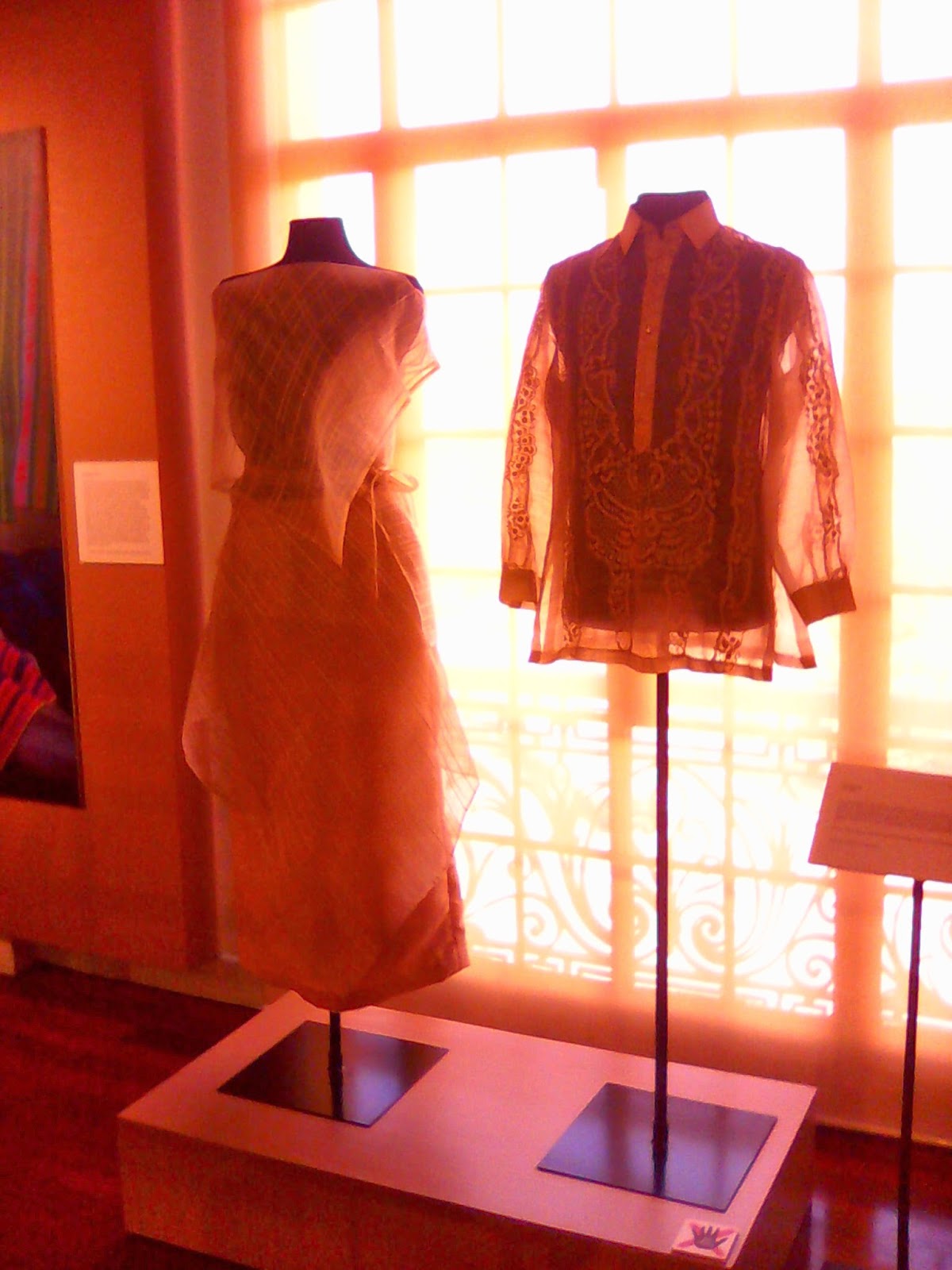
In this instance, I did like the temporary exhibit of the Hibla ng Lahing Filipino Gallery on the fourth floor of the Museum of the Filipino People. Credit goes to Senator Loren Legarda for putting up a worthy collection on the Abel Ilokana in celebration of Women's Month. Clearly, the venerable senator has an advocacy for promoting things Filipino. Her fashion sense and style prompts her to don indigenous fabrics adapted to contemporary designs. She makes it a point to use locally woven fabrics for her clothes in most, if not all of her official functions.


The  Abel Ilokana collection, sadly, will only last until the 30th of March. However, I feel that it's a creative way of highlighting the Filipino's long tradition of weaving. The Abel or Inabel is a type of sturdy cloth that has been part of the Ilocos region's way of life. It is the product of both tradition and function as the northerners tried to keep the art of weaving alive by passing on the knowledge and skill to the younger generation. The art was passed on from grandmother to daughter to granddaughter as most families kept looms in their households.


Formerly limited only to women, the art of weaving became a means not only to keep women modestly and stylishly dressed, it was also a source of wealth and income to support their families. The abel cloth was used not only for clothing but also for their homes as these were turned into table runners, blankets and even mosquito nets (depending on the fine quality of the weave and fibers). The men, nowadays have taken to weaving as well! As a matter of economics, the men have slowly infiltrated the art form once dominated by the Ilokanas. Their strength allows them to make tighter woven fabrics that are also stronger.


There were indeed times in my childhood when my grandmother would often remind us in the  old Filipino proverb; "kung maigsi ang kumot, matuto'ng bumaluktot!" It was also a reference to a simpler way of life to try adapt to the curve-balls that life throws at you! How apropos, considering she would order blankets from Ilocos.  Once banned from being exported to Spain, the inabel was considered a threat to the local Spanish weaving industry. Its sturdiness survived the gale force winds that moved the Spanish Galleons on their long voyage across the Pacific and so it was preferred and often used as sails. Of course, until now, those blankets from Ilocos are prized for their sturdiness. 


I'm happy that Sen. Legarda was able to showcase the fine art of weaving in the north. Nowadays, the abel or inabel has taken on new applications for its use. Glad they re-discovered it before it becomes a dying art...


Saturday, March 15, 2014

THE LEGACY OF A PROUD PEOPLE


It is always a privilege for me to accept guiding duties to the Banaue Rice Terraces. Recently, I was up there with four Dutch guests who were so awed by this man-made wonder. I myself am speechless at the high level of planning and construction the Ifugaos undertook to build this heritage site. And so showing it off to tourists is always a treat.


Other Asian countries like Japan and Mongolia have their own versions of the rice terraces. Ours is different, though. Consider the following facts:
  • The Banaue Rice Terraces are more than 2,000 years old.
  • The Banaue Rice Terraces soars to a height of anywhere from 3,000 -5,000 feet above sea level
  • It covers a total land area of 400 square kilometers
  • If laid end to end, it will run halfway around the globe
  • The Banaue Rice Terraces supports its own ecosystem

What strikes me as extra-ordinary is that there could not have been that many Ifugao settlers in the Philippines many years ago. What our ancestors achieved must have taken immense effort and intensive manual labor on their part to build these rice paddies on the slopes of the Cordilleras.


Even with the encroachment of the Spanish and American colonizers, the indigenous people of the Cordilleras remained true to their culture and their inner resolve to not be subjugated by foreign rulers. They were the incessant mosquito that kept bugging the Spanish colonizers. They would plague the Spanish troops and their commanders with raids that left some of their victims headless. They protected their gold mines and built the rice terraces for survival.


Even until now, as the younger generation prefer to seek jobs in urban centers, those locals left behind make the effort to repair the damaged portions. The Banaue Rice Terraces remains, to this day, a testament to a proud people.


Infolinks