Pages - Menu

Wednesday, July 20, 2016

MOUNT CAYABU, MOUNT MAYNOBA AND 8 WATERFALLS

climbing party vans 1 and 2

After having attended the Coleman Basic Outdoor Course on 9, July, 2016, I was enticed by my Advocates for Heritage Preservation friends (Pheeyah Salones and Ofie Palma) to join them on a trip to the Mount Maynoba circuit. Tour organizer Leigh Tatli assured us of an easy climb and a wondrous experience of a walk in the clouds and a view of 8 waterfalls. Who wouldn't want to go? So I agreed to join them the weekend of 18 July (Sunday). 
my companions in van 2
I was at the appointed pick up point at around midnight so I won't be left behind for the van pick up at one a.m. The van got to the base camp at the foot of the two summits at around three in the morning. After a brief orientation and some reminders of the Leave No Trace principle, we started our ascent at 3:30 a.m. armed with hiking poles and headlamps and some provisions for the day. Our guides were Mang Celso and the sweeper was Christian who led us through paths they were familiar with.

sea of clouds
The difficulty of the ascent was pegged at 3/9. If you think about it, it would normally be an easy climb, but it didn't seem that way since the climb was way before daybreak. It was still dark and the terrain was mostly a steep ascent with wild vegetation and the trail was narrow interspersed with craggy rocks or muddy trail. we could sense the ravines in some parts but the sight of stars overhead kept us going. We had to stop from time to time to catch our breath. Next thing we knew we were going through campsites where the climbers greeted us on our journey. Finally we got to the summit of Mt. Cayabu. Mt. Cayabu's summit is about 400 meters above sea level which was a preliminary climb before one reaches the second summit of Mt. Maynoba.


heavenly view at the summit
The circuit was recently opened on 22, March, 2016 and is fast becoming an item on every mountaineer's bucket list. It was still dark when we summitted Mt. Cayabu so we didn't have as much pictures in the area. We continued hiking up the trail with some deep descents that had roped trailways to prevent us from falling into jagged ravines. Muddy and scary to say the least. One wrong move and impending injury would be the result.


Ofie Palma and Lea Barcinal at the summit marke

The ascent to Mt. Maynoba was more challenging. Some of the steps carved into the trail was still difficult as it was a near vertical ascent. Now, I've been to Banaue many times over but this climb was becoming more technical. Glad I brought my hiking pole! It proved very helpful on this assault. As we were nearing the summit it was becoming light, when I looked behind me i could see nothing but peaks engulfed in a sea of clouds. my mouth gaped open. Then we got to the clearing... finally I could whip out my camera to take my now much adored photos.

campsite of Mt Maynoba
God, Almighty... I worship you for all this wondrous creation! At 662 meters above sea level, Mt. Maynoba's (pronounced may.nu.ba) summit affords one a 360 degree view of the eastern side of Tanay and parts of Quezon province on the west side we could see Montalban, Rizal blanketed by fog as well. Only the Kakawate ridge was visible above the clouds. Note to self... spend a night on the campsite next time so the walk would be more leisurely...


After this, the hike got progressively worse. From a 3/9 it notched up another point to a 4/9. To get to the falls, we've had to ascend up higher on the ridge then descend over the ridge. To reach the falls, the trail got worse and more challenging. I felt my knee buckle twice. Thank goodness I had my hiking pole. Finally, my companions and I could feel the rushing sound of water. However, we couldn't enjoy the water as there were too many people crowding the area. So much for the waterfalls...


natatago'ng paraiso falls
It wasn't a let down, it was just too crowded. So in ordere to enjoy the rest of the falls, we had to go further downstream. Our friend was suffering from dizziness and fainted from the exertion of the assault so she had to be carried on a hammock halfway back to the base camp. The rest of us had to just forego the rest of the falls as we were concerned for our companion. The descent to the base camp was as difficult as well. We found out later while resting at the ranger shack that there were other "casualties" as well. We went through river crossings, over boulders, muddy trails, steep trails narrow pathways with ravines on one side until finally... flat lands! We rested a bit near some rice fields before we got to the bamboo gate that was the start of the trail from the other end of the circuit.


Montalban covered in clouds ; view from the summit of Mt Maynoba
We reached the base camp by 12:30. That was a good 9 hours of hiking! Success!!! We had some cold drinks and Halo-halo before we headed out for lunch at Cafe Katerina along the Tanay ridge (which happened to be closing for the lunch service). We then decided to have lunch at Marcos Highway that was en route to our drop off point at Eton Centris.


me at the summit*
It was worth the effort and sweat, but let me warn you... get enough sleep and rest a day or two before the climb and prepare yourself with lots of cardio routines at least two weeks before so you're not out of breath in getting to the top. The circuit can drain you although the experience can be uplifting as well... 


to the falls with Pheeyah Salones*

*photos from Eileen de Luis, Lea Barcinal, Ofie Palma


Tuesday, July 19, 2016

THE GREAT OUTDOORS


I was fortunate to have signed up for the Basic Outdoors Class organized by no less than Coleman, Philippines last 9 July, 2016. I came across it from a post by my friends Rheeza and Jonathan Hernandez on Facebook and I took the time to visit the Coleman store in Glorietta, Makati.


I was at the venue of the seminar a few minutes prior to the 8:00a.m. call time and was conveniently seated at a table that had a great view of the Bonifacio Global City grounds and American War Memorial. I was told that the previous seminar was conducted at the penthouse of 24/7 Building where the Coleman Corporate Offices were. But the venue was changed at the last minute so there we were at the 15th floor. Ten minutes prior to the start of the seminar, we were provided with cookies, sandwiches and coffee so we could at least listen with full attention without the grumbling hunger pangs after having had no breakfast.

Sir Reggie Poblador
The seminar on the Basic Mountaineering course was handled by Mr. Reggie Poblador. Our trainor's background is very impressive as he, along with Edgar Garduce were able to reach the summit of Mt Everest in 2014. He was formerly with the Ayala Mountaineers in his early years in mountaineering and has since moved on to achieve that rare feat among Filipinos to have been to the highest peak on earth. The other resource person's name is Billy (i forget his last name) who gave us basic knot tying lessons which we can use on our next climb. I'd like to go into the details of both seminars but I'm afraid I can't ruin the experience for inexperienced weekend climbers who need this basic training before they can even go on a camping trip. I must urge interested parties to sign up for the Coleman Basic Mountaineerng course because the lectures and seminar will give them basic knowledge and do's and don'ts in case they want to hike up a mountain on their down time.

Sir Billy
The module 2 of the basic mountaineering course had many participants of different persuasions and age ranges. But most of us were there basically because being out doors was a passion. I for one, started hiking in my twenties while I was working with the Ayala Museum as their gallery specialist. I have since moved on to other endeavors and have lost the opportunity to do climbs until I became a Mabuhay Guide. I have since been able to guide guests up to the Banaue Rice Terraces up in the Cordillera mountain range and to Baguio and Sagada ad also to Taal crater island. This is the reason why I felt the urge to re-discover my inner "mountain man" to be better equipped to guide guests whenever another opportunity arises. I didn't regret going. Some modules were familiar as these guys follow the LNT tenet - Leave No Trace. Good practice to save our environment!


Needless to say, it was a half day that was well spent. After this, there will be a camp out somewhere in Zambales so the participants of this course can actually practice what they learned from the seminar.  At the end of the seminar we were presented with certificates of completion with the end in view of purchasing gear from Coleman on our next adventure. I've got some gear laying around the house from my hiking days so I just need to spruce up on my current gear and go somewhere... 


Tuesday, July 5, 2016

CHASING THE MEXICAN TRAIL


I got a call from Ella Delaza of U-Travel a few weeks ago for an inquiry with a tour. Apparently she had already  contracted a Mabuhay Guide before and was impressed with the quality of our guiding (ehem!) that she needed a guide to show a very important Mexican guest around Intramuros. However, this guest had a particular inclination to see the how deep the Mexican connection was in terms of our colonial life. I was impressed with Ella and U-Travel's desire to bend over backwards to enhance a guest's travel experience. He was, after all, visiting the Philippines for the first time.


I gladly obliged, as I had traveled extensively in Mexico in the 90's and have been convinced ever since that there's only one word to sum up the Manila-Mexico connection - DEEP! And so as the tour date was near, communications between Ella and myself had become more frequent. As it turned out, our guest was particularly interested in a monument. The Mexican Squadron 201! I told Ella that she shouldn't worry as there are so many inferences that point to our relations with Mexico over the centuries.


And so on the 4th of July, as we celebrated the Fil-American Friendship Day, Ella, Marco Aguilar (our guest) and myself were in Intramuros doing the tour. Marco is in the country for the first time as a guest speaker on the topic of success. He is a graphic designer by profession and has worked in marketing and advertising but found his calling as a motivational speaker. He is in Manila for a series of conferences after which he flies off to Cebu and Bohol to experience the country for himself.

there's  a section on Philippine items in Cuernavaca and Acapulco

Many Filipinos seem to have forgotten that despite the fact that we were a Spanish colony, the Philippines was administered from Mexico. So my visits to Mexico paid off as there are collections in Mexican museums in Acapulco  Fuerza San Pedro) and Cuernavaca (Palacio de Cortes) of Philippine items brought over from the Galleon Trade. Our first stop was at San Agustin, of course, since they have dedicated the former Sala Recibidor as the Galleon room. All references on the almost three hundred years of trade from Acapulco to Manila are concentrated in that room. Marco was quite well informed of the galleon trade and was very receptive of the commentaries asking questions here and there as we toured the collections. We went around,  the entire convento and finished shortly before lunch.

Mexican Squadron 201 Monument
Our next stop was the Mexican Squadron 201 Monument. And this is where the tour gets emotional. Apparently one of Marco's uncles was part of the Aztec Eagles that served with the US Air Force to flush ot the Japanese during World War II. The monument to the squadron is located outside of the walls of Intramuros but within the fenced in portion of the golf course. Prior to the tour, I made arrangements with the security detachment that's in charge of the Puerta Sta. Lucia. I'm glad I did as we were allowed to exit the gate to get to the monument. Marco posed for a couple of pictures to show to his uncle who is now a retired commercial pilot. But I got an inside story from Marco on the how the Mexicans were dragged into the war by the US.
Aztec Eagles insignia
When two Mexican oil tankers were destroyed by Germany, the president of Mexico, President Camacho declared war on Germany which was part of the Axis powers together with Italy and Japan. But Marco tells me that it was actually the Americans who blew up the tankers and put the blame on the Germans to coax Mexico to join the war and boost the US firepower which was getting heavily depleted from all the war campaigns they were involved in. Mexico had no other recourse but to join the Allied forces. It is interesting to note that out of all the Latin countries only Mexico and Brazil were involved in World War II with the US.

Of the 300 recruits from Mexico, around 80 were fighter pilots. The rest were military personnel: staff, mechanics, health workers and support staff. They were mostly brought to Texas first were they started training on American planes. At least two pilots died while in training in Texas before they could even see action. The Mexican contingent were then moved to Louisiana and then  brought to the Philippines in the US' Pacific campaign. Five of the pilots who actually flew on missions in the Far East died in the Philippines. Two of them crashed their planes, Two were shot down by Japanese firepower and one of them apparently got lost at sea when he ran out of fuel while while on a flight mission. Their names are inscribed in the monument.


The sad thing about the Mexican effort in WWII was that it was largely unnoticed by the public. They were given military honors upon their return to Mexico definitely. However, a lot of them have been forgotten by the younger generations. This monument of an eagle with a snake in its mouth is even obscured by a larger monument. No one would ever know it was there unless you were looking specifically for it.


In front of the smaller monument is the monument of Miguel Hidalgo. He is Mexico's counterpart of our national hero Jose Rizal. Hidalgo was the son of wealthy parents. He was well-educated and eventually answered his calling to become a Jesuit. Hidalgo, like Rizal, was aware of the abuses of the Spaniards and wrote essays  and articles and also lobbied for reform in Mexico. For that reason, he is hailed as the Liberador de Mexico.


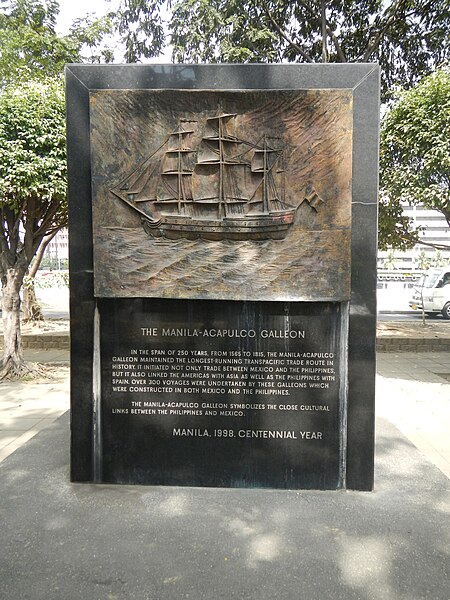
 Even the pioneering efforts of Mexicans who were manning the galleons are not talked about... as if no one really remembers. So I brought Marco to Plaza Mexico with the marker of the Galleon trade and we talked about the parallelisms between Mexico and the Philippines under the yoke of Spanish colonialism.

Galleon Trade Marker in Plaza Mexico, Intramuros*
More than anything, it was trade that spurred the movement of galleons from Acapulco to Manila for 251 years. That did not escape Marco's critical thinking. He surmised that the galleon trade ended also partly due to the fact that Mexico had started the revolution against Spain at around the same time in 1815. Of course Mexico was conquered by Spain ahead of the Philippines.Their independence from Spain came ahead of ours. Even the Mexican-American war was ahead where they lost some of their territories to the US.So this whole tour was very sentimental for our guest. While in Plaza Mexico, I also showed him the friendship marker between Mexico and the Philippines and the monument of President of Alfonso Mateos (1964) who forged the friendly relations with Mexico with then President Diosdado Macapagal. It was a stop at Starbucks Intramuros for some refreshments and a washroom break.

Before we headed off to lunch, we went to Fort Santiago, passing through the Manila Cathedral. Where I showed him the revellin that has been converted into a chapel of Nstra, Sra. de Guadalupe. It was a sweet recollection for me as I recalled my visit to the shrine many years ago to pay homage to our Lady and to pray for my mother's well-being. My prayers were answered as she lived longer before she succumbed to heart failure in 2000.


On many levels this tour was a great success. My guest enjoyed seeing Manila from the Bayleaf Hotel's sundeck. After that, we headed off to Quiapo where I was supposed to show him the Black Nazarene and possibly a peek at the Muslim quarter as it was two days to Eid'l Fitr. But the rain started to pour and it was nearly half past four. so the guest had to get back to the hotel for another activity lined up for him. Many thanks to Ella Delaza and U-Travel for using my services for this tour. Aside from gaining a new friend, it brought back memories of my Mexican sojourn.


Tuesday, June 28, 2016

AHP DOES PAMPANGA 1


Just this past weekend, members of the Advocates for Heritage Preservation descended on the province of Pampanga to visit old churches and again admire the beauty of these heritage structures and have as much fun as we can. Four vans and a few privately owned vehicles convoyed to Pampanga and we found our way towards our first stop.


with Lea Amante Villapando
Minalin, Pampanga
Sta. Monica

The church of Minalin is dedicated to St. Monica. Allow me lift information from the Tourist Guide to Notable Philippine Churches.  


     The town's Renaissance church was built by the Augustinians in 1834, rebuilt in 1854, restored and embellished by Father Isidro Bernardo in 1877 and repaired again in 1885 by Father Galo dela Fuente) and 1895 (by Father Vicente Ruiz). It is 52 meters long, 13 meters wide and 11 meters high and is distinguished by its unique triangular pediment and its array of superpositioned coupled Corinthian columns at the Facade's center.

     The pediment's tympanum is broken into two levels by a horizontal stringcourse supported by coupled Corinthian columns at both ends. Above it is a lantern-like campanille complimented by balusters at the raking cornice. The semi-circular arch of the main doorway and the arch of the window above it are decorated with lavish floral carvings. Twin four-storey, low and squat octagonal bell towers flank the facade. Its frame is a whole composition. Inside the church is a transept and some beautiful retablos. Both the church and the convento are enclosed by a low stone atrium with four capillas posas (a rarity in Philippine churches. Minalin is located 69 km north of Manila.*
Sta. Monica church frescoe

Bacolor

Church of San Guillermo


Located in Barangay Cabambangan, it is one of the oldest and largest churches in Pampanga. This church was probably built by Father Jose Coronel (parish priest from 1617- 1629) on the lot of Don Guillermo Manabat. It was damaged during the 1645 earthquake, a fire in 1672 and suffered heavily during the British Occupation. The church was restored in 1852 by Father Manuel Diaz, damaged during the 1880 earthquake, repaired by Father Eugenio Alvarez in 1886 and Father Antonio Bravo in1897. It was partially buried in six meters of lahar from Mount Pinatubo's 1992 eruption and the church's floor is almost at the level of the windows (the current doorway is the window of the choir loft)

The church measures 56 meters long, 15 meters wide, and 12 meters high. Its central nave has a well lighted transept with windows. The main retablo, side retablo and pulpit are gilded with gold leaf. The richly designed baroque facade has square ionic columns with vertical flutings and ornamented capitals terminating up to the cornice molding. The semi-circular arched main entrance has a smaller window directly above it, all profusely and intricately ornamented. The upper part of the facade has square mouldings, scrolls and volutes and a tempietto at the top resting above the stringcourse of the blind arch.. Its four storey hexagonal bell tower on the left has semi-circular arched openings and is topped by a domical roof topped by a tempietto. Bacolor is located 72 km from Manila and 5 km south of the city of San Fernando.*

Willy Layug and me
The convoy had a  brief stop at the atelier of famous scultptor Willy Layug. This unassuming artist is now world famous after having presented Pope Francis with a statue of Our Lady of Hope. A bozeto of the Madonna is currently in his workshop amongst other works currently in progress. Willy Layug is an alumni of the University of Santo Tomas' Fine Arts program. He has also apprenticed in ateliers in Madrid and Barcelona to perfect his technique in creating santos and retablos. Beautiful life-like images are strewn all over his studio where his workers have their own particular "assignments". A film directed by no less than award-winning Brilliante Mendoza on his life and art are currently in production. Much to our surprise, Willy mentioned that he is willing to give back by accepting apprentices to his workshop. What a humble artist!
Our Lady of Hope by Willy Layug
Betis
St James the Great
** photo from personalgeographic.wordpress.com
Located in Barangay Betis9 founded 2 May, 1572) as a visita of Tondo and later as a visita of Bacolor, it was first built with light materials by Augustinian Father Fernando Pinto, rebuilt with stronger materials by Father Jose dela Cruz and continued from 1660 to 1770. The main nave was finished during the first stage and the transept and facade in 1738. Father Manuel Camanes repaired the church along with the convent between 1868 and 1894. He also built a cemetery and the first artesian well in the Philippines, built at the center of the plaza fronting the church and still existing. The church is now listed as a National Cultural Treasure.

The church is 60 meters long, 16 meters wide, 12 meters high and has a profusely ornamented, two-level, German Baroque facade with decorative, coupled columns and skillfully arranged flora, spirals and intricate curvilinear carvings decorating the projecting portico ( a later addition). The first level has  windows with white painted frames and latticed panels and the second level has a stained glass rose window with a cross as the main design. A frieze decorated with geometric dentil forms, separates the two levels. Its pediment has a huge volute emphasized by two wing-like and receding decorative mouldings.
painted dome
The wooden entrance doors are intricately carved with the "Dreams of Jacob" from the Old Testament. The huge, elaborate retablo is furnished with authentic icons. Spectacular murals of nineteenth century artist Simon Flores as well as father-and-son team of Macario and Jose Ligon (finished before World War II) fill the walls. The interpretation of the Bible is painted on the entire wooden ceiling and dome. The four-storey bell tower, on the church's right, has alternating flat and arched windows and a graceful campanille crowning at the top.  Guagua is located 77 kilometers from Manila and 10 Kilometers south of the city of San Fernando.*
baptistry

Before we headed of for lunch, we stopped at what remains of the Lopez Mansion, took our photos and  then went to lunch at Aling Luring's cafe where we did the obligatory introduction of new members. Indeed the AHP family is growing everyday... After lunch, we were off to Sta. Rita, Pampanga to admire the church.
Lopez Mansion

Sta. Rita
Church of St. Rita


The town's present masonry churh was built by Father Francisco Royo in 1839 and completed by Father Juan Merino in 1868. It is 55 meters long, 13 meters wide, 10 meters high and has a single nave, a large well-lit transept and a solid mass, Baroque like facade. The facade has  relatively slender single columns, triangular windows and a pediment flanked by mini-towers and enlivened by a mini retablo. The church is flanked by a squat, foru-storey bell tower on the left and a stone-arcaded convent on the right. Santa Rita is located 79 kilometers from Manila.*

We explored the town plaza and I ended up with AHP member Esquierdo Bhel Asinas at the grounds of Villa Epifania. The heritage home is owned by the Guanzon clan and was used as the movie set of the award-winning movie Tanging Yaman starred in by Gloria Romero and Lino Brocka's Tinimbang Ka Nguni't Kulang. The house is believed to haunted. Unfortunately, it was closed and the caretaker was not in close proximity. So instead of ghost hunting, we headed to the Lansang-Ocampo residence whose family has been producing famous Pampango delicacies like turrones de mani, Sans rival and also mamon tostado. to get relief from the humidity and heat. some members soothed themselves with buko and avocado sherbet from a lady with a cart.

Then finally we motored to our last stop.


Lubao

Church of San Agustin


The church was first built in Barangay Santa Catalina by Father Juan Gallegos using light materials. The present brick and adobe church was started by Father Francisco Coronel, continued by Father Geronimo de Venasque  in 1635. and completed by Father Francisco Figueroa in 1638. It was damaged during the 1645 earthquake and was enlarged in 1829  using masonry materials. Father Antonio Bravo did some repair work in 1877 while Father Antonio Moradillo worked on the interior decoration in 1893 (the murals depicting the life of St. Augustine were probably done during this time.)

The church was occupied by revolutionaries in 1898, used as a hospital for American soldiers in 1899 and in 1942, during World War II, the dome, transept and roof collapsed during the heavy Japanese bombardment. The main retablo was undamaged but sunken panels and other liturgical ornamentations done by Italian artis Alberoni were lost. It was restored from 1949 to 1954 by father Melanio Garcia but was again damaged during a strong typhoon in 1962. 

The church is 82.45 meters long, 21.12 meters wide, 10.50 metershigh and has 2.54 meter thick walls. The simple, plastered Neo-Classic-style facade has a semi-circular arched main entrance flanked by engaged, fluted pilasters spanned by a lintel arrangement and flanked by small niches. Above the window is a statued niche with a small segmental pediment above it and elegant curvilinear lines flowing from the midsection. An imaginary triangular pediment masks the roof.

Its only nave was originally painted by Dibella and Alberoni, both Italian artists. The central retablo 
is flanked by rectangular openings with triangular segments as well as coupled pilasters on the first level and single columns on the second level. The five-storey, 31 meter high stone and brick bell tower, still unrestored, has two square stories and three octagonal. The convent, at the opposite end of the church is profusely ornamented. Lubao is located 83 kilometers from Manila and 16 kilometers south of the city of San Fernando.*

After documenting all of these places, we went back to Manila on separate routes and we were home by sundown... There will be another trip to Pampanga in the near future... it's just begging to be explored even more...


*Tourists Guide to Notable Philippine Churches, Benjamin Locsin Layug, New Day Publishing, 2007 

Infolinks